
File myapp.fc
myapp.fc defines the file security contexts, it has the following content:
/usr/bin/myapp -- gen_context(system_u:object_r:myapp_exec_t,s0)
The /usr/bin/myapp binary will have context with the type myapp_exec_t when running commands like restorecon, fixfiles.
Restoring file context automatically
Omarine by default runs a service that restores file context automatically. It is restorecond service

However, this service only applies to files and directories listed in the configuration file /etc/selinux/restorecond.conf. By default the binaries in /usr/bin are not applied. To clarify this, we copy myapp into /usr/bin and see its security context, as the root user:
cp myapp /usr/bin/
ls -Z /usr/bin/myapp

The type of /usr/bin/myapp is bin_t rather than myapp_exec_t as we wish.
Now we add /usr/bin/ * to the /etc/selinux/restorecond.conf configuration file, the result is as expected:
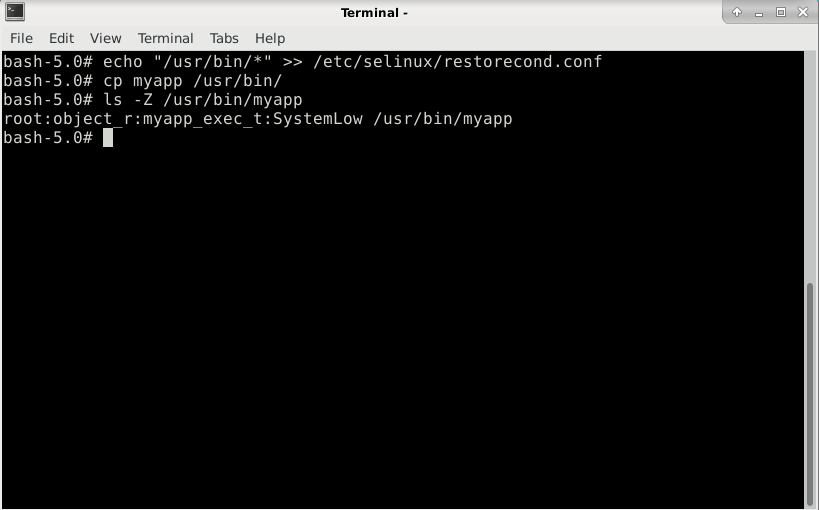
Here the security context computing process preserves the user field of the file security context, which is root. If you want, you can change it to system_u by running the command chcon, as the root user:
chcon -u system_u /usr/bin/myapp
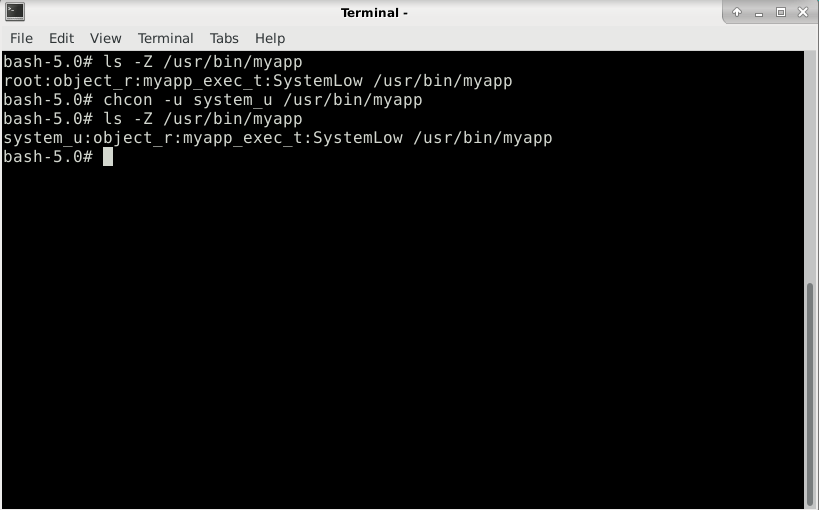
You can also set the file context permanently by running the semanage command as follows

 Artificial Intelligence Kiosk
Pingback: SELinux with omarine policy: An in-depth look at the security policy – secure program with its own domain: Part 5 | Artificial Intelligence Kiosk